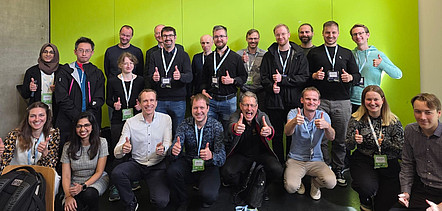
5. GI Quantum Computing Workshop
The GI Quantum Computing Workshop 2026 took place on September 24th and brought together researchers, practitioners, and innovators to explore the latest developments in quantum technologies.
The GI Quantum Computing Workshop 2026 took place on September 24th and brought together researchers, practitioners, and innovators to explore the latest developments in quantum technologies. As the annual meeting of the German quantum computing community, the workshop provided a comprehensive platform for knowledge exchange and collaboration, spanning the full spectrum from hardware and algorithms to compilation and real-world applications.
The workshop opened with a keynote from Ingolf Wittmann, who presented the current status of quantum technologies and ecosystems in Europe and Germany. The morning program continued with Alena Koltun's work on the construction of Petz recovery maps for single-qubit quantum channels and Rinor Kelmendi's evaluation of QAOA variations regarding noise susceptibility. Practical and methodological perspectives followed with Marc Maußner (together with co-presenter Volker Reers) on architectural resilience against adversarial attacks in quantum neural networks, and Nick Poser presenting a domain-specific language for formulating hybrid quantum-classical meta-solver strategies. Robert Wille then discussed the road towards a modular interface for integrating quantum computing into HPC, before Cheng-Lin Hong addressed the trade-offs between chemical accuracy and quantum algorithmic cost in transcorrelated quantum chemistry.
After the lunch break, the focus shifted to hardware and applications. The afternoon keynote by Hermann Heßling explored realtime quantum machine learning for next-generation observatories, followed by Wolfram Langheinrich's presentation on single-electron shuttling devices for a scalable quantum processor fabricated in an industrial CMOS line. Mustafa Musab introduced a quantum-classical framework for bidirectional EV charging and trip assignment, and Alexander Noack presented high-performance Gbps-quantum random number generation as well as a highly scalable, ready-for-deployment quantum key distribution system. The day continued with Lars Schütze on QHLO, an MLIR-based high-level quantum optimizer, and Sakineh Ghaderi on interface-annotated backend descriptions for resource-aware compilation of NV-centre spin registers. The workshop concluded with Saba Arshad's exploration of position-dependent entanglement-assisted quantum walks with a GHZ coin state.
With its diverse program spanning hardware, algorithms, compilation, and applications, the GI Quantum Computing Workshop 2026 proved to be a catalyst for exchange and innovation, underlining the importance of collaboration in advancing quantum technologies in Germany and beyond.